
Grief
9 Things That Actually Helped in the First Year of Grief — From Women Who've Lived It
No platitudes, no five-step plans. Nine things that genuinely helped real women get through the first year of loss — including the ones nobody says out loud.

Not what people said would help. What actually did.
If you've lost someone, you already know that most of what gets said to you in the first year is for the comfort of the person saying it. "They're in a better place." "At least it was quick." "You're so strong." None of it helps, and some of it quietly hurts. So we asked a different question. We asked women who have been through it — widows, daughters, sisters, friends — not what people told them would help, but what genuinely did. The small, real, sometimes odd things that got them from one week to the next.
Their answers had almost nothing in common with the advice on the sympathy cards. They were plainer than that, and kinder. If you're in the thick of it now, take what's useful and leave the rest. There is no right way to do this, and nothing on this list is homework.
1. Lowering the bar to "fed and watered"

In the early months, the women we spoke to didn't talk about routines or goals. They talked about survival at its most basic: did you eat something today, did you drink some water, did you sleep at all. One widow told us her sister's only question, every evening for months, was "fed and watered?" — and that it was the single most useful thing anyone did, because it was a bar she could actually clear. Grief is physically exhausting in a way nobody warns you about. Your brain is doing enormous work underneath, and there is simply less of you available for everything else. So the laundry waits. Toast counts as dinner. A shower is an achievement, not a baseline. Lowering the bar isn't giving up. It's an accurate assessment of what this year is.
2. One person who lets you tell the same story twice

Not a crowd of supporters. One person — sometimes two — who will hear the story of the last day, or the diagnosis, or the phone call, again. And again. Without flinching, without steering you towards the bright side, without that small glance that says we've covered this. Telling it repeatedly isn't dwelling; it's how the mind slowly makes something unbearable real. Several women said the friends who mattered most weren't the ones with wise words — they were the ones who just kept turning up and letting them talk in circles. If you have one person like this, lean on them; they can bear more than you think, and most consider it an honour. And if you're reading this as the friend: you don't need to say anything good. You just need to stay.
3. Rituals you invent yourself

The official rituals — the funeral, the flowers, the scattering — are over quickly, and often feel like they belonged to everyone else. The rituals that helped were the private, invented ones. His mug, still used every Sunday. A candle lit on the 14th of each month, because that was the date. Her roses, deadheaded on Saturday mornings the way she did it, secateurs and all. One woman still watches the snooker with her late husband's chair angled towards the telly, and reports the scores aloud. It sounds daft written down, she said — and then did it anyway, because it helped. That's the whole test. Nobody has to understand it, approve of it, or even know about it. If a small strange ceremony keeps a thread between you and them, it's doing its job.
4. Saying their name out loud

Around six months in, something painful happens: people stop mentioning them. Not from cruelty — from fear of "setting you off". But the silence is worse than any tears could be, because it makes the person you loved start to feel erased. Every woman we spoke to said some version of the same thing: say their name. The friend who says "Derek would have hated this weather" over coffee is giving you a gift. So the women who coped best gave themselves permission to go first — dropping his name into conversation, telling her stories at dinner, saying "my husband used to say" without apologising for it. Yes, sometimes it brings tears. The tears were already there. What saying the name actually brings is the person, back into the room, where they belong.
5. The admin binder

Nobody warns you about the paperwork. In the same weeks your world has ended, you are expected to become a project manager: the death certificate copies, the banks, probate, the pension people, the utilities, the driving licence, the mobile contract, the subscriptions that keep renewing in their name — each one a phone call, a queue, and the sentence "I'm ringing because my husband has died" said aloud to a stranger, again. The thing that contained it, for woman after woman, was almost embarrassingly simple: one folder, and one hour a week. Everything goes in the folder — letters, reference numbers, a running list of who's been told. Then one fixed hour, tea in hand, to make the calls. When the hour's up, the folder closes and the admin is not allowed to follow you round the house. It doesn't shrink the mountain. It stops the mountain being everywhere.
6. Moving your body, gently

Not a fitness plan. Nobody grieving needs a fitness plan. But grief lives in the body — the crushing tiredness, the tight chest, the 4am wakings — and the body, it turns out, is one of the few doors you can reach it through. The women we spoke to swore by the modest stuff: a walk to the postbox that slowly became a walk round the block. Swimming, because you can cry in a pool and nobody knows. Digging over a flowerbed with more force than the flowerbed strictly required. One said her daily walk was the only place she could think about him without the house pressing in. Ten minutes counts. Moving slowly counts. The point isn't progress; it's giving the sadness somewhere to go, on days it has nowhere else.
7. Permission to laugh
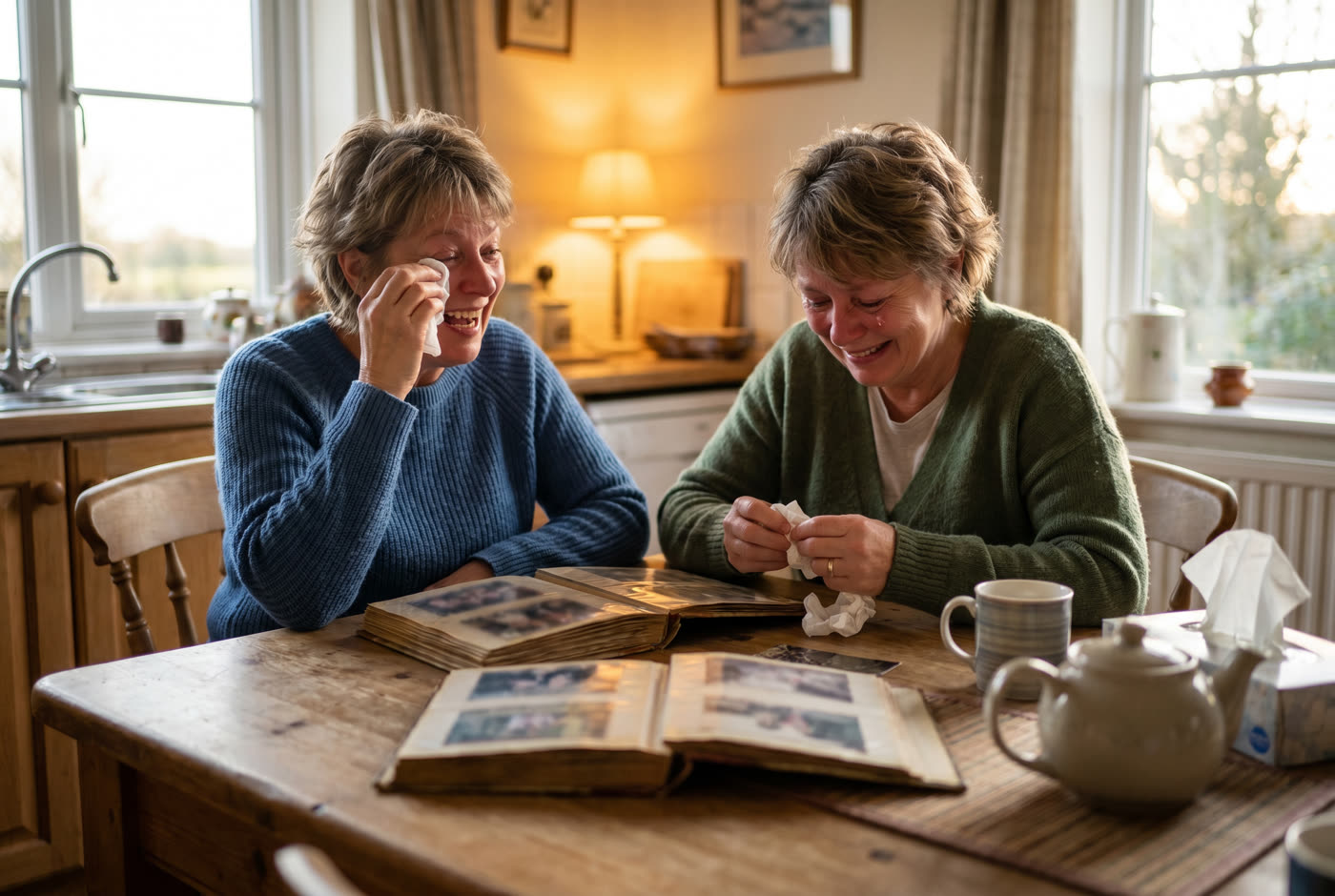
At some point — often shockingly early — something will be funny. The undertaker's toupee. The thing he would have said about his own eulogy. The casserole rota descending into farce. And you will laugh, properly, and then feel a wash of guilt, as if joy were a betrayal. It isn't. Every woman we spoke to remembered her first real laugh, and most remembered the guilt that came with it — and every one of them, further down the road, said the laughter was part of the loving. You do not honour someone by being destroyed without intermission. The people who loved us generally liked our laugh; they would recognise it as ours. Grief and laughter are not opposites taking turns. They sit in the same room, often in the same hour, and both of them are telling the truth.
8. A grief group — later, when you're ready

Almost nobody wanted a group in the first weeks; the idea of a circle of strangers felt unbearable. But somewhere down the line — four months, eight, a year — many women found that sitting with people who actually knew was a relief nothing else touched. No explaining. No managing anyone else's discomfort. Just people who understand why an aisle in Sainsbury's can undo you. If and when you're ready: your GP can point you to local bereavement support, and Cruse Bereavement Support offers a helpline and groups across the UK — many women told us Cruse was where they finally said things out loud they'd been carrying alone. Hospices often run open bereavement groups too, whether or not your person died there. And if you go once and hate it, you're allowed to leave. Ready means ready — not obliged.
9. Accepting it's a spiral, not a staircase

Forget the tidy version, where you climb through five stages and come out "recovered" at the top. The stages were never meant as a timetable, and grief doesn't take instructions anyway. The women we spoke to described something more like a spiral: you come back round to the same grief — the birthday, the anniversary, the song in the car — but each time from slightly further out, with slightly more of yourself intact. Month eight can be worse than month two; that's not relapse, it's often just the numbness wearing off. The most freeing thing, several said, was realising a terrible day didn't mean they were "doing it wrong" or losing ground. There is no schedule to fall behind. You are not failing at grief. There is no way to fail at it.
You don't have to be doing this well
If you've read this far and thought I'm not managing even half of that — that's fine. This was never a checklist. Some of the women we spoke to did one of these things. Some did none, for a long time, and simply endured, and that counts too. The first year isn't a test you pass. It's a year you get through, however you get through it — fed and watered, some days barely that.
Be gentler with yourself than the world has been. That's the whole instruction.
If you'd like company along the way — we write one honest, unhurried email a week for women in their second act, on the hard things as well as the good ones. No hype, no fixing, no pretending. Join Her Honest Review — it's free. →
Written and edited by our team. See our Editorial Standards.
Keep the honest ones coming
Get the next tested review in your inbox
No hype, no spam, no brand paid to be here — just what actually works, from women who tried it first.